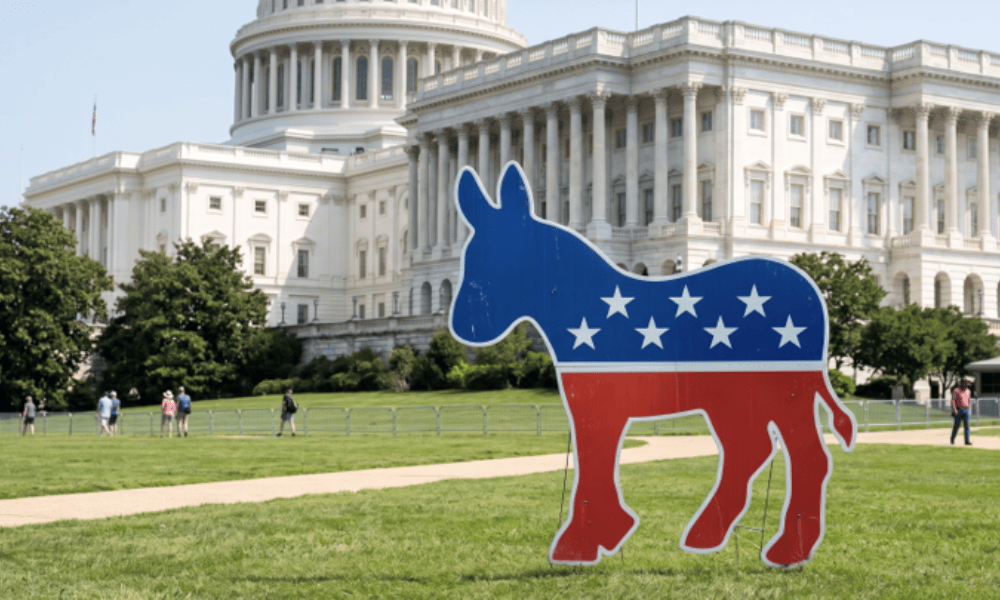
The Democratic Party's capture of both the House and Senate in Tuesday's midterm elections marks a decisive shift in Washington's balance of power, with immediate consequences for fixed income, technology equities, and digital assets. By early Wednesday, U.S. stock futures were modestly higher as investors began parsing the policy implications of a unified Democratic Congress.
The bond market responded swiftly: the 10-year Treasury yield fell 4.7 basis points to 4.918%, while the two-year yield dropped 3.7 basis points to 4.597%. The dollar weakened 0.5% against a basket of major currencies. Matthew Ryan, head of market strategy at Ebury, noted that a Democratic Congress is likely to temper the administration's fiscally expansionary agenda, easing deficit concerns and reducing upward pressure on yields. However, he cautioned that the practical impact may be limited, given the president's veto power and the unlikelihood of a two-thirds Senate majority to override it. The real fiscal test, he said, will come with debt ceiling negotiations in 2027.
Technology and artificial intelligence stocks face a more adversarial regulatory environment. Rep. Greg Casar (D-TX), chair of the Congressional Progressive Caucus, has called for AI company CEOs to testify under oath, while Rep. Robert Garcia (D-CA), presumptive chair of the House oversight committee, delivered a blunt warning: "Lawyer up." These signals suggest heightened scrutiny of AI practices, data privacy, and market power.
The data center industry, a key beneficiary of the AI boom, is also in the crosshairs. Texas is projected to surpass Virginia as the world's largest data center market by 2030, according to JLL. Newly elected Texas Governor Gina Hinojosa has pledged to push state lawmakers to regulate the AI data center sector, which could pressure data center REITs and utilities tied to AI power demand. President Trump has also weighed in, urging developers to offer "dividends" to local residents to gain community support.
Cryptocurrency regulation is another area of concern. A CNBC analysis of Federal Election Commission records found that crypto, AI, and online gambling interests spent over $377 million on the elections, with most of that money backing losing candidates. A Democratic-controlled Congress is expected to pursue tighter oversight of digital assets, particularly in the wake of the recent Binance hack that saw more than $6 billion stolen from accounts.
Advisors are advised to review client portfolios for exposure to these vulnerable sectors. George Efstathopoulos of Fidelity International views the midterms as a "clearing event" and suggests a gradual re-entry into tech, arguing that fundamentals and prices have diverged. Michael Arone of State Street Global Advisors warns that the bigger risk is investor overreaction rather than the election result itself.
Historical context offers some reassurance: Wells Fargo & Co. analysis shows the S&P 500 has risen in the 12 months following every midterm election since World War II. Near-term volatility, therefore, may not be indicative of medium-term direction. Still, a proactive portfolio review is warranted, especially for clients with significant holdings in technology, semiconductors, AI infrastructure, data center REITs, and cryptocurrencies.
For advisors, the key is to communicate these shifts clearly and before markets force the conversation. The regulatory landscape has changed overnight, and client strategies should reflect that reality. As the political dust settles, the focus will shift to how these policies translate into market performance—and whether the historical post-midterm rally holds true this time.



