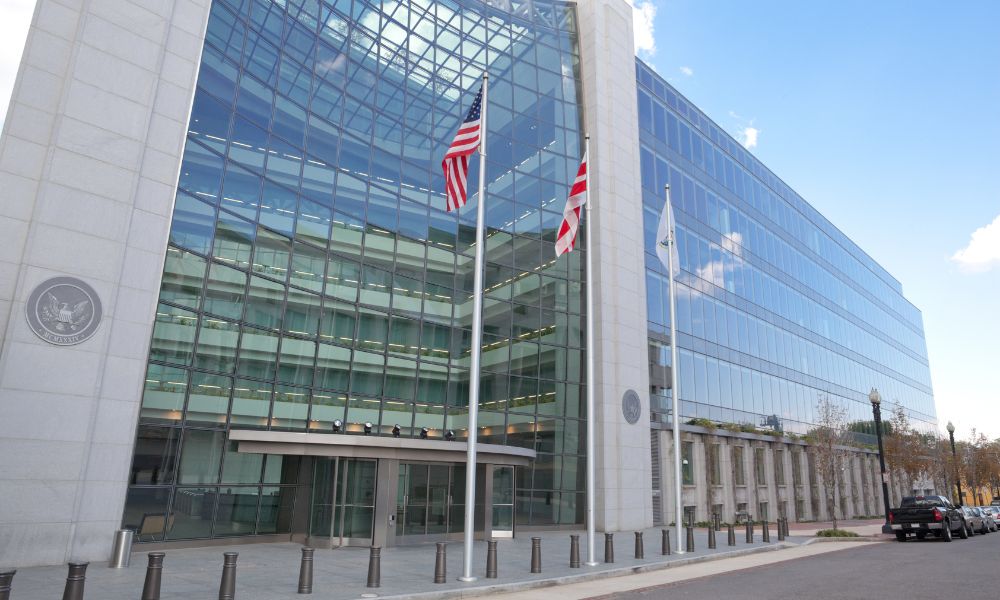
The Securities and Exchange Commission has adopted a rule change that could accelerate several pending proposals affecting registered investment advisors, including one that would permit performance fees of up to 20% of net gains. The amendment to the agency's quorum requirement, which had stood for 31 years, was approved on Sept. 30, 2026, and took effect two days later, coinciding with the departure of Commissioner Hester Peirce. That leaves the SEC with just two members: Chair Paul Atkins and Commissioner Mark Uyeda.
Under the previous rule, a quorum required three commissioners, or fewer if fewer held office. With only two in office, the disqualification of either one would leave the commission unable to act. The new rule, however, permits a single commissioner to act on behalf of the entire agency when all other sitting commissioners are disqualified from a matter. Benjamin Schiffrin, director of securities policy at Better Markets, a Washington, D.C.-based nonprofit that advocates for stronger financial regulation, said the change will affect RIAs primarily through the pace of rulemaking rather than their day-to-day operations.
What the quorum change means for RIA fees
At the same Sept. 30 meeting, the SEC proposed a rule that would allow advisors to registered funds and business development companies (BDCs) to charge performance fees of up to 20% of net gains, according to a report from Gibson Dunn. The proposal also seeks to redefine the term "qualified client"—the status that determines who can be charged performance fees—to include any accredited investor. A companion proposal would ease restrictions on interval funds, which permit investors to redeem shares only at set intervals. Additionally, the package considers letting certified financial planners, CFA charterholders, and CPAs qualify as accredited investors.
Schiffrin noted that the new quorum rule removes a potential obstacle to finalizing these proposals. "If one of the two remaining commissioners can't participate in a matter because they're disqualified due to a conflict of interest, the one remaining commissioner can still act on behalf of the commission," he said. This applies whether the disqualified commissioner is Chair Atkins or Commissioner Uyeda, he added.
Why conflicts could stall a two-member SEC
Schiffrin identified two types of conflicts that could trigger the new rule. A financial conflict arises when a commissioner owns stock in a company that a rule could directly affect. A personal conflict occurs when a commissioner previously worked for or represented an affected firm. SEC ethics staff screen for both, and commissioners can divest assets before taking office to reduce financial conflicts. "The personal conflicts are harder," Schiffrin said, because past client work cannot be undone. With a full five-member commission, the loss of one commissioner's perspective is usually manageable, but with only two seats filled, that cushion is gone.
The old rule already allowed a lone commissioner to act when only one held office, as is currently the case at the Commodity Futures Trading Commission, where Chair Michael Selig serves as the sole member. The SEC's new rule extends that power to situations where two commissioners hold office but one is disqualified. Schiffrin noted that a previous SEC commission considered a similar change in 1995 and declined to adopt it, drawing the line at allowing a lone commissioner to act only when just one held office. "Clearly a previous commission said 'that's a bridge too far for us,'" he said. "And I don't think this commission did a good job of explaining why it wasn't a bridge too far for them."
What RIAs should watch
Schiffrin does not expect the quorum change to alter an advisor's daily practice, but it does remove a possible stall on proposing and finalizing rules, as well as on voting in enforcement cases. That matters to advisors tracking the performance-fee proposal and the shift in who qualifies to pay those fees. He also doubts the rule will change outcomes, noting that the two remaining commissioners "seem to be pretty in lockstep with the current commission's agenda." Atkins has pushed forward with a proposed shift to semiannual reporting despite opposition from retail investors, and with a proposed rescission of the trade-through rule, which requires trades to execute at the best displayed price, despite opposition from large financial firms.
Uyeda defended the change in a Financial Times opinion column, arguing that it clarifies that a quorum can exist when all but one commissioner is disqualified. Schiffrin remained skeptical, saying, "Given that the SEC is intended to be a five-person commission, there really shouldn't be that many situations where one person can act on behalf of the commission."
For advisors, the practical implications may be limited in the near term, but the rule could speed up decisions on proposals that have been pending. As the industry watches, the SEC's ability to move forward with a two-member commission—and potentially a single acting commissioner—will be a key factor in how quickly new rules are adopted. For more on how advisors are adapting to regulatory changes, see this analysis of the OBBBA's estate and tax changes. And for a look at how RIAs are using tax-efficient strategies, see this report on active ETFs and Section 351 exchanges.



