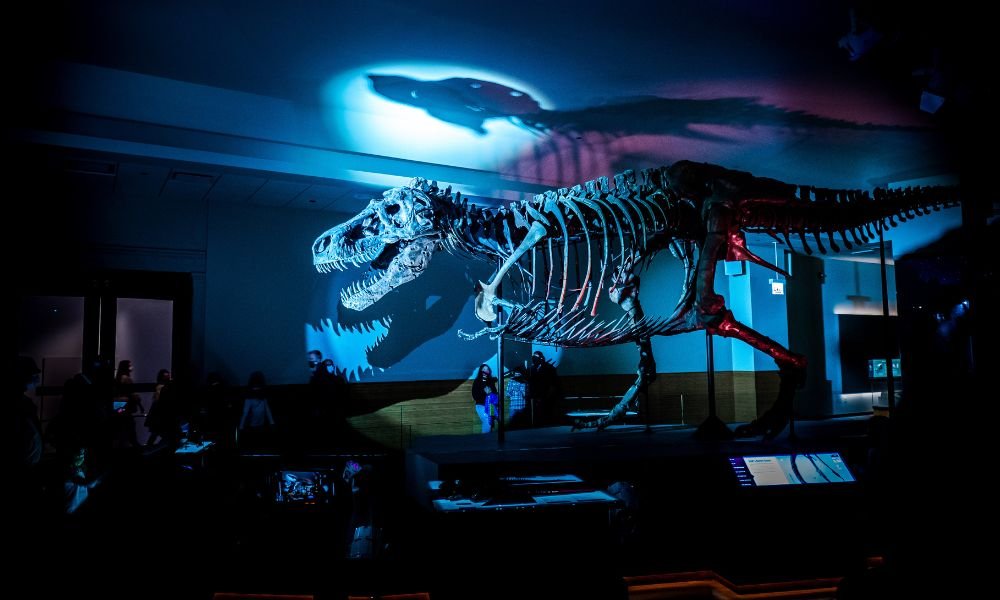
Sotheby's is set to auction a near-complete Tyrannosaurus Rex skeleton named Gus on July 14, with a pre-sale valuation of $30 million and a minimum opening bid of $19 million. The sale, which begins at 10 a.m. ET from the auction house's Madison Avenue saleroom in New York, features 168 lots of fossils, minerals, and natural history artwork. Bidding is open in person, by phone, or online, targeting ultra-high-net-worth collectors who have increasingly turned to prehistoric artifacts as alternative assets.
Gus, recovered from Badlands terrain in South Dakota, is named after the late cattle rancher Gary Licking, on whose land the specimen was found. The excavation team spent three years extracting the fossil and another three documenting and reconstructing it. Cassandra Hatton, Sotheby's global head of natural history, noted that Gus is one of the largest and most complete T. rex ever discovered, with 61% of its bones identified. The skull bears a large bite mark, possibly from a battle, and several ribs show healed fractures, adding to its scientific and aesthetic appeal.
The auction traces its roots to 1997, when Sotheby's held its first natural history sale featuring a dinosaur—a T. Rex named Sue that sold for $8 million to Chicago's Field Museum. At that time, museum buyers dominated the bidding. The market has since evolved dramatically. In 2020, a T. Rex called Stan sold for $31.8 million, and the current auction record for any dinosaur belongs to a Stegosaurus named Apex, which Sotheby's sold in 2024 for $44.6 million to Kenneth Griffin, founder of hedge fund Citadel. Griffin has since loaned Apex to a museum.
Beyond Gus, the catalogue includes a separately sold leg, a partial jaw with four unusually dark teeth, an individual claw, and multiple teeth from Hell Creek Formation sites in Montana and South Dakota. Other lots feature a juvenile Gryposaurus skeleton, a pair of nestling hadrosaurs found with their eggshells, a Brachylophosaurus preserving skin impressions, an Allosaurus jaw preparation, a Stegosaurus dorsal plate, ammonites, ichthyosaurs, Eocene fish fossils, and petrified wood, alongside natural history artwork.
For financial advisors guiding clients interested in such assets, the fossil market's history offers cautionary lessons. According to CFA Institute research, a Triceratops skeleton failed to meet its reserve price at a 2008 sale amid the financial crisis, underscoring how sensitive prices can be to broader market conditions. Sue's 1997 result, meanwhile, was partly driven by the cultural moment around the Jurassic Park films, not just scarcity. Specialists cited by the CFA Institute point to preservation quality, reconstruction accuracy, completeness, whether a mount comes from a single individual, and presentation as key value drivers, with carnivore specimens commanding the highest prices.
The rising prices are increasingly shutting scientific institutions out of the market, according to Susannah Maidment, a dinosaur researcher at London's Natural History Museum. This trend mirrors broader dynamics in alternative investments, where ultra-high-net-worth individuals compete for tangible assets. For advisors, understanding these pricing swings is critical, especially as clients diversify into collectibles. As noted in recent analysis, inflation and market volatility are prompting investors to seek hard assets, though fossil prices remain niche and illiquid.
The auction also highlights the growing intersection of wealth management and alternative assets. While not a traditional investment, dinosaur skeletons offer diversification and potential appreciation, but liquidity risks and high transaction costs persist. Advisors should weigh these factors against clients' overall portfolios, particularly as the market for such items becomes more competitive. The sale of Gus could set a new benchmark, but as the 2008 Triceratops example shows, even the most impressive specimens are not immune to economic downturns.


