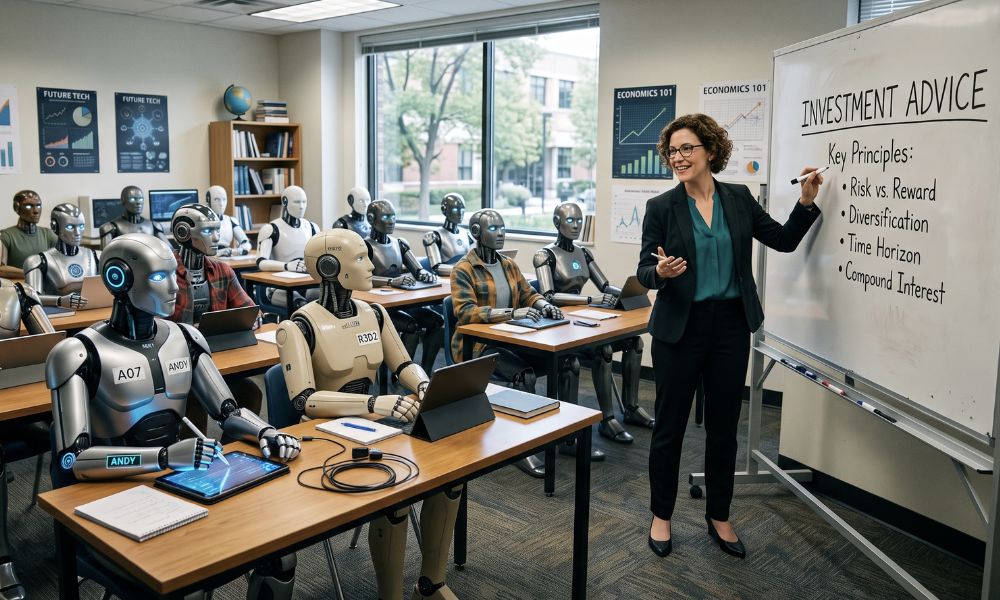
A growing number of financial advisors are being recruited to train artificial intelligence systems that could eventually automate their own roles. Startups such as Mercor and Handshake are paying experienced professionals—including CFPs, CFAs, and CPAs—between $90 and $150 an hour to help design, test, and refine AI models for wealth management, retirement planning, and investment advisory tasks. These figures come directly from job postings and have not been independently verified.
Mercor, founded in 2023, is reportedly in talks about a funding round that would value the company at roughly $20 billion, double its valuation from earlier this year, according to The New York Times. Handshake, a recruiting startup that pivoted to AI data work in 2025, told the Times its annualized revenue run rate surpassed $1 billion in April, up from $550 million at the start of the year—a figure not independently verified. The trend has drawn attention from major outlets, including The Wall Street Journal and the Financial Times.
These companies are moving beyond low-paid overseas workers tagging images. Brendan Foody, Mercor's 23-year-old CEO, told the Times that capturing the collective output of entire firms is "the bottleneck to a frontier lab automating everything that people do." Mercor has acquired a startup that builds simulated versions of software like Slack and Salesforce, allowing AI to learn how professionals operate at firms like Goldman Sachs.
Job boards now list finance-specific projects where contractors evaluate an AI's investment thesis, calibrate retirement-income models for suitability, and check simulated advisory conversations for compliance—tasks that junior advisors and paraplanners traditionally learn over years. This raises concerns about the apprenticeship model, as firms may have less incentive to hire junior talent if AI can absorb expertise from experienced advisors in a few hours a week.
Survey data from next-generation advisors indicates that roughly three-quarters of senior industry leaders expect AI-driven restructuring to hit junior roles hardest, nearly twice the rate expected at mid- or senior levels. Even advisors who see upside in AI—70% of those surveyed this spring report using at least one AI tool—are generating training data through their daily work. Michael Mignosi, senior director of organic growth at Perigon Wealth Management, expects the value of advisor thought leadership to erode as AI enables anyone to "sound like an expert" instantly.
Danielle Li, a management professor at MIT Sloan, has argued in the Financial Times that this pattern deserves scrutiny across white-collar work. Her research on call centers found that AI access helped newer agents by encoding top performers' techniques, but once expertise is encoded into a model, it no longer belongs to the worker who supplied it—and that worker typically isn't compensated further. In extreme cases, highly skilled workers may train systems that allow firms to replace them with less experienced, lower-cost staff.
For advisors, the implications are clear. Li advises professionals to think carefully about how much of their process—client scripts, planning templates, objection-handling playbooks—they hand over to employers or training vendors, and to push for direct compensation when that knowledge becomes a reusable asset. The rise of AI training platforms suggests that the industry's assumption that only back-office roles are at risk may need revision.
As firms like MassMutual emphasize that AI enhances efficiency but cannot replace human trust, the data points from every client meeting and every prompt run through an AI tool are building a repository of expertise that could reshape the advisory profession. The question remains whether advisors will be compensated for contributing to that repository—or whether they are unwittingly training their own replacements.


