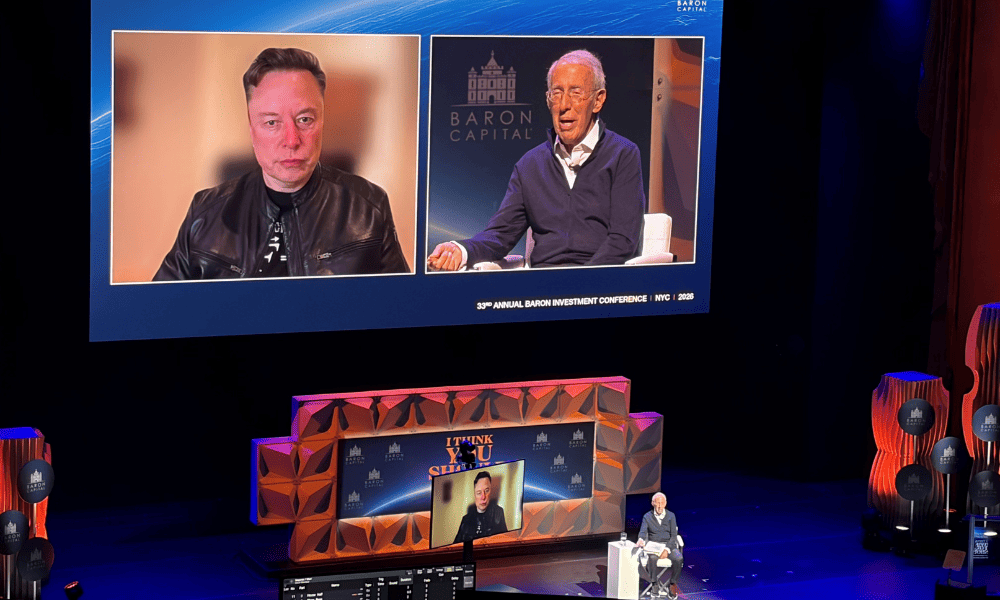
Elon Musk used his appearance at the Baron Investment Conference on Friday to argue that the next frontier for artificial intelligence infrastructure is not on Earth but in orbit. Speaking via video link to an audience at the Metropolitan Opera House in Manhattan, the SpaceX chief executive said that terrestrial data centers face mounting opposition from communities and regulators, a dynamic he described with a blunt metaphor: “The pitchfork level for data centers is pretty high.”
Musk’s comments come as utilities and grid operators struggle to meet surging electricity demand from AI workloads. He contended that space offers a way around those limits, noting that solar panels in orbit can generate power around the clock without atmospheric interference. “You get 30% more solar power in space,” he said, adding that the lack of nightfall means only a minimal battery pack is required.
The SpaceX founder revealed that the company has already tested the concept with small payloads. “There’s a satellite with an NVIDIA GPU up there that we launched, and there’s a satellite we recently launched with a Google TPU,” he said. The Google Tensor Processing Units are part of Project Suncatcher, a research initiative focused on scalable machine-learning infrastructure in space.
Musk also outlined SpaceX’s own Starmind project, which aims to capture solar energy in orbit and beam computing power back to Earth via a satellite constellation. He said the first Starmind computers, co-designed with NVIDIA, could launch as early as the third quarter of 2026. “We’ll start off slow, but then it will ramp to significant volume probably in ’28, and then very, very large volume in ’29,” he predicted.
The economics, according to Musk, hinge on the cost of reaching orbit. He argued that the fully reusable Starship rocket could cut launch costs by a factor of 100 or more, making space-based data centers competitive with ground-based facilities. “The cost of intelligence in space is dramatically less than the ground once you have a low cost per ascent to orbit,” he said.
Musk’s vision is not without skeptics. Terrestrial data center developers face long interconnection queues and community backlash, but space-based alternatives raise their own questions about latency, maintenance, and debris. Still, the potential market is enormous: Musk said that reaching terawatt-scale AI compute would require “200 gigawatt per year” of new capacity, a level he believes is unattainable on the ground.
The announcement comes as SpaceX prepares for a major test of its Starship system. According to the Teslarati website, the company is targeting Nov. 13 for its Starship 15 mission, which would mark the first attempt to catch the ship via the launch tower. That milestone is seen as critical to achieving the rapid reusability that Musk says will drive down costs.
For financial advisors, the developments carry implications beyond the technology itself. SpaceX’s valuation and its AI-related revenue growth have made it a focal point for clients holding concentrated positions. The company’s staged lockup structure and recent share transfers have prompted advisors to revisit risk-management strategies for high-net-worth investors.
Musk’s remarks also touched on the broader energy debate, echoing themes from his other ventures. He has previously warned that AI could outpace electricity supply, and his latest proposal suggests he sees space as a way to sidestep terrestrial constraints. Whether regulators and investors share that view remains to be seen, but the conversation is likely to intensify as launch costs fall and AI demand grows.



