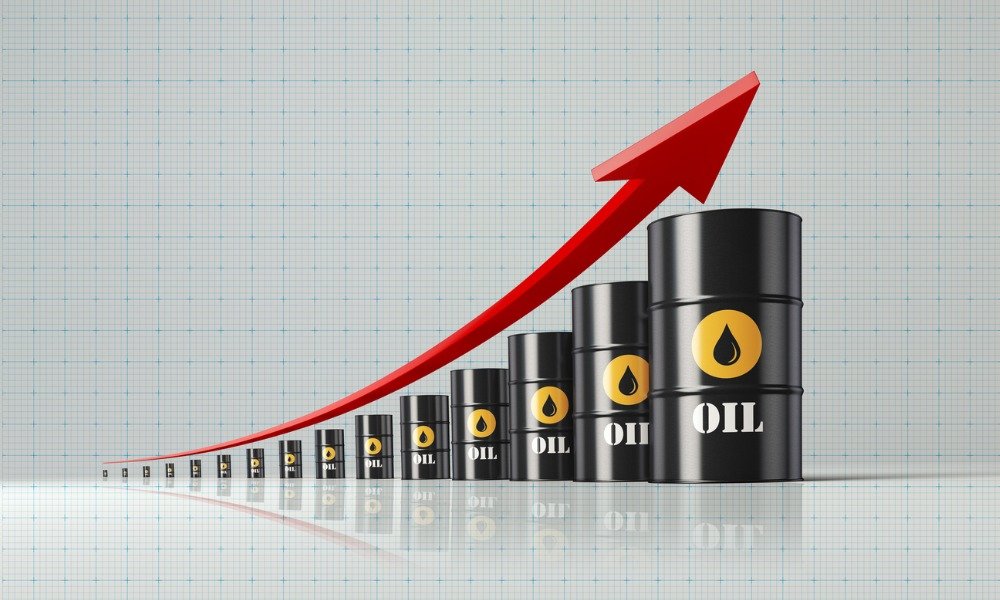
Oil prices surged to multi-year highs on Tuesday, with Brent crude climbing 1.7% to $102.07 a barrel in early European trading on September 22, 2026, while West Texas Intermediate rose 1.7% to $97.40, according to the Wall Street Journal. The rally comes despite U.S. Central Command reporting that the volume of oil, natural gas, and cargo transiting the Strait of Hormuz over the past two weeks hit a six-month high, underscoring that markets are pricing in geopolitical risk rather than actual supply losses.
The sustained spike in crude is complicating the Federal Reserve's path to lower interest rates. Chicago Fed President Austan Goolsbee said at the Semafor World Economy conference that rate cuts could be pushed into 2027 if oil-driven inflation persists. "The longer this goes, if inflation stays up, that pushes cuts out of 2026," Goolsbee said, a stark reversal from his earlier expectations of multiple cuts this year. The Fed has held its benchmark rate at 3.50%–3.75% since December 2025, but at the September 16, 2026, FOMC meeting, it raised the target range to 3.75%–4.00%. According to CME FedWatch, there is a 53.1% probability of another hike to 4.00%–4.25% at the October meeting.
The Fed's updated Summary of Economic Projections now sees median headline PCE inflation at 2.7% for 2026, up from a prior 2.4% estimate. Some analysts at CMC Markets warn that continued energy pass-through could push PCE back toward 3.0%, which would keep the central bank on hold well into next year. For advisors, this means the conventional rate-cut thesis is stalling, and portfolios must be positioned for a higher-for-longer environment.
Beyond crude prices, a less-discussed but critical transmission channel is the cost of shipping oil, which has skyrocketed. The cost of shipping crude from Saudi Arabia's Ras Tanura terminal to Ningbo, China, has risen to nearly $63 million per voyage from around $4.5 million before the conflict, according to Michael Haigh, head of commodities research at Societe Generale. Supertanker rates on the Baltic Exchange's benchmark Middle East-to-China route have surged to approximately $800,000 a day, according to OilPrice.com. Kpler expects VLCC earnings to remain above $100,000 a day into early next year—more than double the historical norm of around $45,000.
Research published in March 2026 by Christina Anderl of the Bank of England and Alessandro Nava of the University of Padova, examining 43 oil-importing and oil-exporting economies from 2000 to 2024, found that inflation responses to oil shocks are more persistent when shipping conditions are under pressure. Their conclusion is pointed: oil-price monitoring alone is insufficient—shipping conditions must be part of the inflation surveillance picture. This has direct implications for advisors who rely on energy prices as a leading indicator.
Goldman Sachs' commodities desk estimates that every $10 sustained increase in Brent crude adds roughly 35 basis points to U.S. headline CPI over six months, according to analysis reported by Hayes News Network. At current price levels, that would keep the Fed sidelined well into next year. For client portfolios, companies with strong balance sheets, consistent cash flows, and pricing power are generally better equipped to navigate inflationary environments, while sectors such as energy and materials may benefit directly from higher commodity prices—but consumer discretionary and transportation-linked holdings may face headwinds.
The diplomatic picture remains the swing factor. Lukman Otunuga, head of market research at FXTM, said oil markets are caught between Middle East supply risks and prospects for diplomacy, according to the Wall Street Journal. Confirmation of direct U.S.-Iran talks at the United Nations General Assembly could weigh on prices by raising expectations for increased regional supply, while any renewed escalation could push crude materially higher. U.N. Secretary-General Antonio Guterres said over the weekend that dialogue between the U.S. and Iran was essential but would likely take place outside New York.
Advisors should also monitor maritime regulatory actions that could further tighten shipping capacity, and Goldman's updated crude forecasts flag a potential $120 risk if tensions escalate. Meanwhile, U.S. GDP growth held at 2.1% in the latest S&P Global reading, with AI investment partially offsetting the disruption. For now, the rate-cut window has effectively closed for 2026, and advisors must recalibrate expectations for 2027.