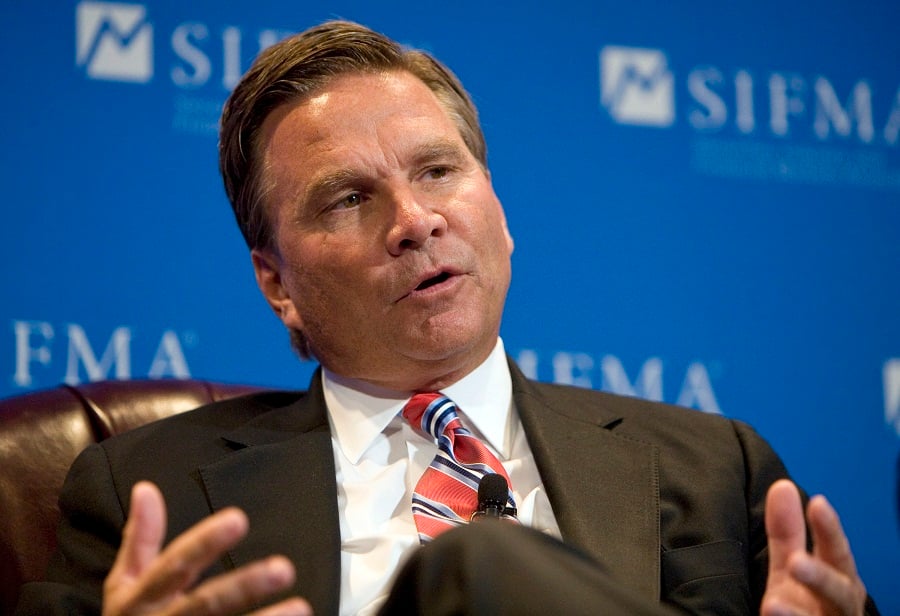
Stifel Financial Corp. CEO Ron Kruszewski offered a measured view of artificial intelligence during the firm's first-quarter earnings call on Wednesday, acknowledging its ability to boost advisor productivity while questioning its suitability for tasks requiring human judgment.
“The models are mathematically driven, and they're great at summarizing, organizing, helping you solve math,” Kruszewski said. “When you move to judgment, which is what our advisors do, it just really isn't that good, and I'm not really comfortable thinking that we're going to serve our clients with some consensus-building mathematical AI, to be honest with you.”
His comments come as wealth management firms increasingly adopt AI tools. Raymond James, Savvy Wealth, and Altruist have rolled out AI products to streamline operations and tax services. Meanwhile, startups like Anthony Pompliano's ProCap Financial, Range, and Era have positioned their platforms to potentially replace human advisors entirely. For a broader look at how AI is reshaping the industry, see Generative AI in wealth management: the productivity dividend, finally.
Kruszewski sees AI as a complement, not a replacement. “I believe, at least on the advisor side, that [AI] will make our advisors more productive. It will unearth, potentially, more opportunities, more ideas, more things on tax savings, more on estate, more things that will help our advisors do what they do,” he said. “I see this as a tailwind to advice, not a headwind. It's a more sophisticated version. We've seen it in the past with robo-advisors and a number of things.”
Stifel reported net revenue of $1.48 billion for the first quarter, the second-highest in the firm's history and an 18% increase from $1.26 billion a year earlier. In October, the St. Louis-based brokerage sold its Stifel Independent Advisors unit, which had roughly 110 registered representatives and $9 billion in client assets, to Equitable Advisors.
“Across Stifel, we're seeing real benefit from our AI investment,” Kruszewski added. “The technology enables our advisors, our investment bankers, our commercial lenders, and support teams to work faster and smarter. In every case, we're working to enhance client relationships with AI, keeping our professionals at the center of the value proposition.”
Kruszewski also raised concerns about Anthropic's new AI model, Mythos, which recently triggered emergency cybersecurity responses from banks and government agencies globally. Independent broker-dealer LPL Financial and wealthtech firm Orion have partnered with Anthropic to integrate its AI wealth management plug-ins. For more on how LPL is navigating the competitive landscape, see LPL and Osaic capture $1.4B advisor team in dual breakaway from Raymond James.
“I'd be less than candid if I didn't raise a concern about frontier models like Mythos that are becoming an entirely new category of technology,” Kruszewski said. “Models this powerful increase capability on both sides of the table, for those defending and for those who would do harm. If you ask me what our industry needs to get right before anything else, the answer is cyber. Not just for Wall Street. This requires a national response.”
His remarks underscore a growing debate in wealth management: how to harness AI's efficiencies without ceding the human judgment that clients expect. As firms like Wells Fargo launch AI-enhanced platforms, the balance between automation and advisor-led advice remains a key strategic question. See Wells Fargo Launches AI-Enhanced Advisor Gateway; UBS Splits Florida Market for more on industry moves.