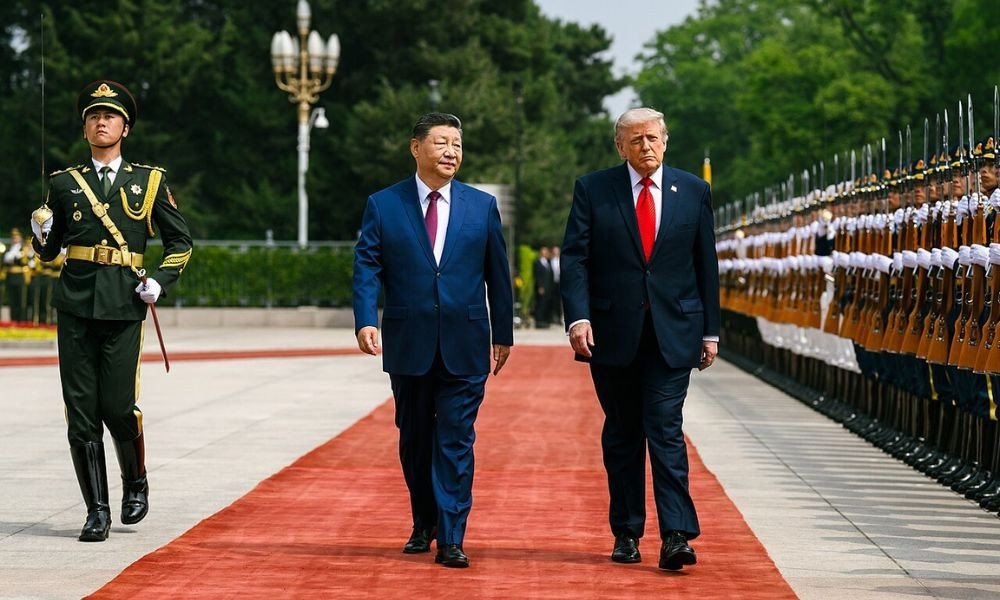
President Donald Trump's visit to Beijing this week for talks with Chinese President Xi Jinping marked a potential reset in U.S.-China trade relations after years of friction. The summit, held at the Zhongnanhai leadership compound, produced several commercial agreements, though many specifics remain undisclosed. Trump characterized the trip as "incredible" and said the two countries had "settled a lot of different problems."
Among the announced deals, Trump stated that China agreed to order 200 aircraft from Boeing (BA), with the potential to increase that figure to 750 planes. Additionally, GE Aerospace (GE) will supply approximately 400 to 450 engines as part of the arrangement. Xi is expected to visit the U.S. in September for reciprocal discussions. "Like reciprocal trade, the visit will be reciprocal," Trump said in Beijing.
Separately, Kevin Warsh was confirmed this week as the new Federal Reserve Chair, succeeding Jerome Powell. Warsh, a former Fed governor, takes the helm amid ongoing tensions with the White House over interest rate policy. The Fed has held its policy rate steady at 3.5% to 3.75% since its last cut in December 2025, resisting pressure from Trump to lower rates.
The latest inflation data complicates the outlook. The Producer Price Index (PPI) surged 6% in the latest reading, the largest jump in over three years, following a higher-than-expected Consumer Price Index (CPI) report earlier in the week. These numbers have increased speculation about the Fed's rate path under Warsh. For more on the inflation data and rate hike odds, see Warsh Takes Fed Helm as PPI Surges 6%, Rate Hike Odds Climb to 39%.
Rick Gardner, chief investment officer at RGA Investments, noted that "uncertainty continues to be lifted from stocks driven by Warsh's confirmation as Fed Chair, stable Iran headlines, and progress on the U.S.-China relationship." However, he acknowledged that hot economic data may prevent near-term rate cuts. "While it may be difficult for incoming Fed Chair Warsh to cut interest rates in the near-term given the hot economic and inflation data, we believe the markets can withstand this," Gardner said.
Equity markets have shown resilience despite geopolitical headwinds. The S&P 500 and Nasdaq both hit new intraday and closing highs on Thursday, boosted by strong tech earnings. The Dow Jones Industrial Average closed above 50,000 for the first time since February. However, futures pointed lower Friday, with S&P 500 contracts down 1.2% and Dow contracts down 0.9%.
The latest earnings season has been a key driver. At Goldman Sachs' RIA Professional Investor Forum in New York, Lindsay Rosner, head of multi-sector investing, described the recent run of U.S. corporate earnings as "absolutely remarkable." For a deeper look at earnings strength, see Goldman Sachs: S&P 500 Earnings Surge 17% in Q1, Best in 15 Years Excluding COVID and Tax Cuts.
Gardner added that while stock valuations are elevated, they are justified by underlying earnings strength. He also noted that if not for the Iran conflict overhang, stock prices would likely be higher. For context on those tensions, see Strait of Hormuz Tensions Weigh on Markets as Trump's 'Project Freedom' Lacks Clarity.
Advisors should monitor how the new Fed chair navigates inflation data and trade developments. The combination of a confirmed Fed leader, progress on China trade, and robust corporate earnings provides a supportive backdrop, but hot inflation and geopolitical risks remain.